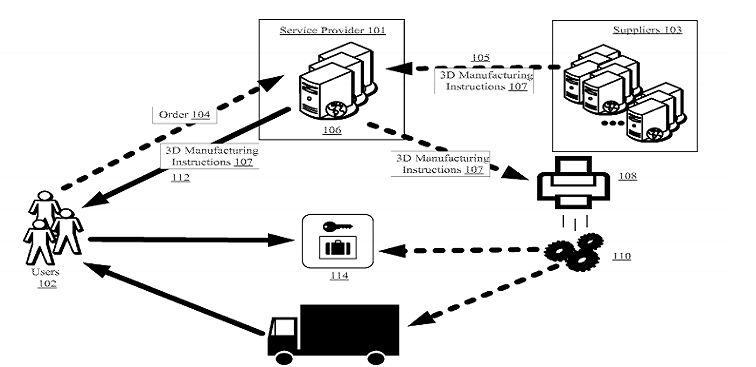
• according to 3Dprint.com, late last week United States Patent and Trademark Office published a patent filing by Amazon Technologies, Inc. which outlines a method of 3D printing on-demand within mobile manufacturing hubs.  According to Amazon, such a setup could save the company time and money on several fronts.

    “The multiplicity of items offered may require the electronic marketplace owner/operator to maintain a large inventory requiring sufficient space to store the inventory,” states the filing. “An electronic marketplace may also face the challenge of time delays related to the process of finding the selected item among a large inventory. Increased space to store additional inventory may raise costs for the electronic marketplace. Additionally, time delays between receiving an order and shipping the item to the customer may reduce customer satisfaction and affect revenues generated. Accordingly, an electronic marketplace may find it desirable to decrease the amount of warehouse or inventory storage space needed, to reduce the amount of time consumed between receiving an order and delivering the item to the customer, or both.”

    p2

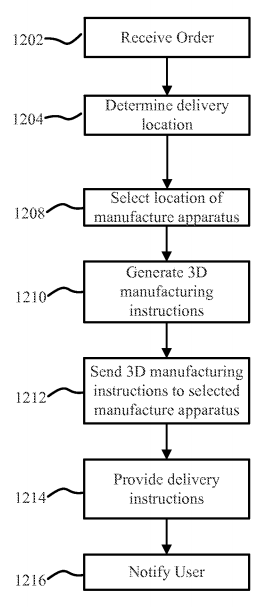
    By utilizing ‘mobile manufacturing apparatuses Amazon would be able to send an STL file to a mobile unit that’s closest to a customer, providing it with instructions to print out an item which was ordered. When the item has been completed, it could then be within miles of the customer who ordered it and quickly delivered or picked up.p1

    The mobile hubs, according to the patent filing, would include a means to both additively and subtractively manufacture an item. This could include a number of different 3D printing technologies as well as CNC machining tools, which would ultimately reduce Amazon’s reliance on warehouse space as well as the robots and employees needed to sort through these stored items.

    Of course every patent that’s filed does not materialize into an actual product or service, but as 3D printing technology continues to progress and competition for delivery speed picks up, this is certainly something I could see Amazon eventually putting to use. Now we just have to wait for the drones which 3D print items 10,000 feet above the earth and can deliver items within minutes.

  • Ann Grakin of ChainLink Research wrote an excellent piece on last mile delivery costs. Guess what! They are very expensive and can seriously impact retail and e-commerce margins. As Ann points out, however, once trained,  consumers wants their stuff as soon as they can get it, so the trend is unlikely to decellerate any time soon. 

    If you want to understand all aspects of what it costs to get your orders delivered to the home or business, check it out…


  • According to PEHubEle.me, a food delivery service based in Shanghai, announced this afternoon (link via Google Translate) that it has raised $350 million in Series E funding from CITIC, Tencent, JD.com, Dianping.com, and Sequoia Capital.

    The investment is notable because Tencent, e-commerce company JD.com, and restaurant review site Dianping.com are closely aligned. Investing in Ele.me, which operates throughout China, can potentially help all three businesses build their online-to-offline (O2O) strategies.

    Tencent owns a 15 percent stake in JD.com and a 20 percent stake in Dianping.

    Alibaba and Baidu, Tencent’s main rivals, already have investments in food delivery services. Alibaba backs Meituan, while Baidu holds a majority stake in Nuomi. Both Meituan and Nuomi are group-buying sites that recently launched food delivery services.

    In its announcement, Ele.me (which means “hungry yet?” in Chinese) said it will continue to operate independently. The company, which serves 250 cities, with 200,000 restaurants and 20 million users on its platform, said that in 2014 its total order volume reached 110 million renminbi, with 75 percent of orders made through its mobile apps.


    O2O is an important market for companies like Tencent, Baidu, and Alibaba to tackle because it allows them to leverage their existing network of websites and mobile apps to bring users into traditional brick-and-mortar stores, therefore opening up more ways to make money.

    Alibaba’s O2O plays include affiliate Alipay, China’s leading mobile payment services company, as well as promotions that its various online marketplaces run with brick-and-mortar retailers.

    Tencent can potentially use Ele.me to power food delivery services on WeChat, China’s top messaging app. Several businesses, including Chengdu-based “Call A Chicken,” already use WeChat to connect with customers. Adding food delivery would add to the roster of services WeChat already offers in China, including the ability to hail taxis from Didi Dache, another Tencent investment.

  • Founders often speak about their start ups as having a destination–acquisition, IPO, independent company, whatever. I tell them there is no such thing as a destination for a company, only a journey. Few companies have an actual end to a journey–they can morph into something else, continue as a subsidiary or move ahead under new management. It's most important for a founder to focus on a journey as that is the exciting part of their trip.

    A destination is like the dog catching the rabbit on a race track, kind of a downer, and results in a 'no race' ruling. The journey is the where the action is, where you get a chance to shape the future and to be part of creating something no one else has ever done.

    So focus on the journey, entrepreneurs and enjoy the ride, because the destination can often be disappointing, unless all you care about in money…

  • Instacart, our favorite grocery delivery company, joins the ranks of the unicorns, with a $220 million dollar raise on a $2 billion dollar valuation. According to Re/code, this comes just six months after Instacart raised $44 million at a valuation of about $400 million in a round led by Andreessen Horowitz. It has now raised a total of about $275 million since it started in 2012 and its other investors include Sequoia Capital, Khosla Ventures, Canaan Partners, Y Combinator President Sam Altman and Box CEO Aaron Levie.

    The Wall Street Journal reports that there have now been more than 40 start ups that raised money worldwide at a valuation of $1 billion or more, double the number at the start of the year. Adjusted for inflation, there are now 70 of these so-called $1 billion unicorns, about twice as many as there were at the top of the tech bubble in 1999 and 2000.

    As I have often noted in this Blog, the hundreds of local delivery companies are ripe for consolidation, as any good supply chain guy can tell you that supply chain is all about scale and greater scale means lower costs as one can better optimize routing, warehouse space and planning activities.

    Perhaps not just yet, however. We need to go through a shakeout period where the weak fall and the strong then get acquired. This would be a normal pattern for either strategic or PE acquirers–wait and see who wins and loses in a new space, them sweep in and pick up the winners.

    We'll see if anyone like FedEx or UPS gets antsy and goes after some of these guys earlier. They did make some interesting acquisitions in 2014–Bongo and iparcel, in particular. 

    Check out some interesting statistics on the food delivery world from CB Insights.


  • According to Boston Business Journal, with the boom in e-commerce orders around the world, there's only one problem, specifically for apartment dwellers: Those packages that you've ordered are piling up in your lobby and someone might take them.

    Medfield-based Package Concierge Inc., a maker of so-called digital lockers for apartment buildings and college dorms, aims to fix that problem. The startup recently raised $1.3 million in equity funding, according to a recently regulatory filing.

    Although the company could not immediately be reached for comment, theJan. 28 filing lists three investors.

    The lockers from Package Concierge are constructed from steel, and the kiosk, powered by the Windows 8 operating system, contains a security camera. The lockers allow access for delivery services like UPS or FedEx to drop off packages without requiring the assistance of an apartment building's management personnel. Residents can access their packages by swiping a key fob across a panel, forcing their locker door to open.

  •  

    According to PE Hub, Roadie, Inc, a mobile app that tries to link up people who need things delivered with drivers with unused passenger capacity in their vehicles, has launched with $10 million in Series A funding. Investors participating in the funding round include UPS Strategic Enterprise Fund,TomorrowVenturesWarren Stephens of Stephens Inc.Guggenheim Partners Executive Chairman Alan SchwartzSquare co-founder Jim McKelvey, the Mellon Group and former ISSCEO Tom Noonan.

    Press Release

    Roadie, Inc., launched today with $10 million in Series A funding and its Roadie mobile app that people use to get items where they need to be by tapping into the excess capacity of passenger vehicles already on the road.

    Investors participating in the round include the UPS Strategic Enterprise Fund, Eric Schmidt’s TomorrowVentures, Warren Stephens of Stephens Inc., Guggenheim Partners’ Executive Chairman Alan Schwartz, Square Co-founder Jim McKelvey, the Mellon Group, and former CEO of ISS Tom Noonan, among others.

    “Roadie is unlocking a transportation heatmap to light up the sharing economy in a meaningful way,” said Court Coursey, Managing Partner, TomorrowVentures. “It’s a win-win for everyone because consumers get their items delivered more efficiently using excess cargo capacity already on the road, and drivers get extra cash and other benefits in return for helping someone out.”

    “Like the disruptive innovation Uber has brought to the transportation industry and Airbnb has brought to lodging, we see Roadie bringing a similar value to the shipper market,” said Warren Stephens, CEO, Stephens Inc.

    “UPS continues to invest in innovation,” said Rimas Kapeskas, Managing Director of the UPS Strategic Enterprise Fund. “We believe that mobile and the sharing economy are active spaces, generating many creative and intriguing business models, like Roadie. Our Strategic Enterprise Fund is all about staying connected to evolving business models and new technologies.”

    How it Works
    Roadie is the first neighbor-to-neighbor shipping network. Senders post details and pictures of the items they want to send. Roadies respond based on location and timing with their availability to deliver.

    The Roadie app enables efficient, low-cost delivery for senders and rewards drivers for trips they were already taking, offering members of the community a variety of benefits including free roadside assistance, roadside discounts, and tax write-offs on miles they were already driving.

    Roadie and the Sharing Economy
    Roadie is the newest entrant in the sharing economy, leveraging a collaborative model, which is now trusted by 68% of consumers worldwide, including more than half of all people in North America, according to a Nielsen survey. While disruption of industries such as transportation and lodging has been widely reported, a new model has yet to emerge to solve the challenges faced by the $90B shipping industry, which struggles to meet the growing consumer demand for same day, next day and out-of-the-box shipping options.

    “There’s an invisible grid under all of our feet made up of the patterns and places we go every day, driving to work, on vacation and just running errands,” said Marc Gorlin, founder and CEO of Roadie. “We designed Roadie to tap into the excess capacity moving along that grid. There is a low cost for the sender, extra cash for the driver and the potential to make the world a better, greener, friendlier place,” said Gorlin, who also co-founded Kabbage Inc., Pretty Good Privacy (PGP) and VerticalOne Corporation.

    Pricing and Availability
    Roadie fees are calculated based on a combination of factors, including mileage and urgency, and range from $8 to $150. Pricing in the Roadie beta app is fixed, making payments easy and hassle-free, with no bidding, bartering or in-person exchange of cash.

    The Roadie app is now available for download in the iTunes Store and on Google Play.

    About Roadie Inc.
    Roadie, headquartered in Atlanta, has created an app-based community that puts unused capacity in passenger vehicles to work by connecting people with stuff to send with drivers heading in the right direction. Roadie’s model enables efficient, low cost delivery for senders and rewards drivers for trips they were already taking. Roadie is backed by Warren Stephens of Stephens Inc.; the UPS Strategic Enterprise Fund; Eric Schmidt’s TomorrowVentures; Guggenheim Partners’ Executive Chairman Alan Schwartz, Square Co-founder Jim McKelvey; the Mellon Group; former CEO of ISS Tom Noonan, and H. Barton Asset Management, among others.

    To learn more about the world’s first neighbor-to-neighbor shipping network, visit http://www.roadie.com
  • It's the ugly backwater of logistics, but apparently a very profitable one. Returns are rarely spoken about but are a huge pain to deal with and very expensive. This has led to the development of specialized companies who deal with returns, refurbishment and resale–the famous 3 R's of reverse supply chain. Now, top tier VCs like Kleiner are taking note…

    Optoro Inc., a Lanham, Md.-based provider of asset recovery solutions for distressed inventory, has raised $50 million in Series C funding. Kleiner Perkins Caufield & Byers led the round, and was joined by Generation Investment Management and return backers Revolution Growth, Grotech Ventures and SwaN & Legend Venture Partners.

    Look for more investment in this space, especially in specialty returns areas, like cell phones and electronics which can be resold in the rest of the world for a profit, instead of being scrapped.

  • Well, here we are in 2015 and your start up desperately needs new employees, especially engineers, product or user experience people, right?  You and a hundred other companies in your backyard are in the same boat. How do you find good people fast?

    Here are a few thoughts on the best places to find them:

    Traditional Job Sites–you might as well post to the usual job and alumni sites, but these are never very useful except for generating a lot of paper to read…some examples:

     http://venturebeat.com/jobs/  Venturebeat


    https://www.linkedin.com/job/venture-capital-jobs/  LinkedIn


    http://www.northeastern.edu/careers/employer/post-a-job/  Northeastern Alumni job board


    Passive candidate sites–Your best candidates already have a job, and may be tempted to look if their identity is kept anonymous until they are really interested in speaking to a potential employer. Here are a few of the newer sites:


    https://poachable.co/ Anonymous job finding site for employees (employers post jobs)


    http://www.poachtapp.com/ another anonymous job fining site


    http://www.switchapp.com/ another anonymous site


    Networking–The best way to find new employees, in my experience. I use LinkedIn and Facebook to post to my network. Also get your current employees motivated to probe their networks by offering a cash reward for any friend hired (payable if they stay six months an ddon't get fired).


    Good luck and get going early!

  • According to bizjournals, Baxter the robot is now even more ready for life "outside the cage." That's how Jim Lawton, chief marketing officer for Boston-based robot makerRethink Robotics, describes Baxter's new software update, called the Robot Positioning System. The company recently released a software update for its manufacturing robot, Baxter, giving the robots much more mobility in a manufacturing or distribution setting..

    Traditionally, industrial robots were "confined in cages" and bolted down to the floor, while using specific location coordinates to identify objects for any given task.

    Rethink Robotics' newest software update allows its manufacturing robot Baxter to become mobile (at the request of a human, of course) and quickly move around from task to task in minutes instead of days or weeks. The robot is also now able to identify objects even after they've been bumped or shifted accidentally or on purpose. The robot can do that because of the new positioning software, as well as cameras in its hands and in its head.

    "It can detect when something has shifted, reorient itself, and continue to do its task, and all that can be done without anybody reprogramming it or tweaking any code," Lawton said in an interview.

    The robot can do that because of the new positioning software, as well as cameras in its hands and in its head.

    Lawton said he doesn't know of any other industrial robot that has this advanced positioning technology integrated into it. The technology has been in the works for months, though the robot's technology has been slowly advancing toward this moment since the development of Baxter in 2008.

    "We've programmed the robot's operating system to think about objects and the orientation of those objects relative to one another as opposed to absolute coordinates in space, and that dates back to the original inception of Baxter," Lawton said.

    See the robot in action in the video clip

    Robot mobility, like the Kiva Systems robots in Amazon's warehouses, is critical to building flexibility and efficiency into supply chains. It's good to see the robot manufacturers realizing that fact.